

 VidHex — Enhance video quality with AI
 Enhance video details and clarity with AI technology and get stunning, high-quality video in any scenario.
Ultimate Guide to General AI: From Narrow Applications to Human-Level Intelligence

In the current era of digital transformation, we are surrounded by specialized algorithms. From the playlists curated by Spotify to the facial recognition unlocking our phones, AI is everywhere. However, these systems represent only a fraction of what researchers hope to achieve. We are currently in the age of "Narrow AI," but the ultimate frontier is General AI.
General AI represents a machine’s ability to understand, learn, and apply knowledge across any intellectual task that a human can perform. Unlike the tools we use today, which are "narrowly" focused on specific datasets, AI general intelligence seeks to create a flexible, autonomous mind. This article explores the general AI definition, compares it to current technologies, and highlights the tools bridging the gap between today’s reality and tomorrow’s potential.

Contents:
Part 1. What is General AI?
To truly grasp the future, we must first answer: what is General AI?
General AI, also known as Artificial General Intelligence (AGI) or Strong AI, refers to a type of artificial intelligence that can successfully perform any intellectual task that a human being can.
The General AI definition centers on "versatility." A system with general intelligence AI doesn't just recognize patterns; it understands context. If a human can learn to play a musical instrument, cook a meal, and solve a physics equation, a General AI should theoretically be able to do the same without needing separate, isolated programming for each task.
In the hierarchy of intelligence, AGI sits comfortably in the middle:
• Narrow AI (ANI)Specialized in one area (e.g., DeepBlue, Siri).
• General AI (AGI)Human-level intelligence across all areas.
• Super AI (ASI)Intelligence that far surpasses the brightest human minds.
Part 2. General AI vs. Narrow AI: Understanding the Gap
The distinction between General Intelligence AI and Narrow AI is the difference between a calculator and a mathematician.
Narrow AI (Weak AI), which constitutes 100% of the AI we use today, operates under "Weak AI" parameters. It is brilliant but brittle. For example, an AI trained to identify cancerous tumors in X-rays is saving lives, but if you ask that same AI to play a game of Solitaire or write a poem, it fails completely. It has no context of the world outside its specific dataset.
General AI (Strong AI) breaks these silos. A General AI agent could theoretically analyze the medical X-ray in the morning, learn to play Solitaire during its lunch break, and write a poem in the evening, transferring the logic and learning capabilities from one domain to another. This is known as Transfer Learning - the ability to take knowledge gained in one context and apply it to a novel, unrelated context.
While Narrow AI relies on pattern matching within a specific dataset, General AI would rely on a comprehensive "world model," allowing it to understand cause and effect, physics, and social dynamics.
Part 3. Theoretical General AI Examples
As of 2026, true Strong AI does not yet exist in a fully realized form. However, we can look at theoretical General AI examples and "sparks" of AGI in current research:
1. The "Universal Assistant": A digital entity that doesn't just execute commands but understands your goals, manages your finances, designs your house, and provides emotional support - all within one integrated consciousness.
2. Self-Evolving Research Agents: Systems that could autonomously conduct scientific research, hypothesize new laws of physics, and design experiments without human guidance.
3. Multi-Modal Large Language Models: Advanced versions of current LLMs (like GPT-5 or Gemini 2.0) are showing "sparks" of AGI by demonstrating the ability to reason across text, image, and code, though they still lack true physical world-understanding and consciousness.
Part 4. Major Hurdles to Achieving AGI
The path to AI general intelligence is fraught with technical and ethical obstacles:
Computational Power: The simulation of 10^14 to 10^15 connections made by the human brain requires a lot of energy and hardware, which is also well beyond what is currently globally available.
The "Common Sense" Problem: While AI can map the trajectory of a falling glass, it doesn't "understand" what a glass is and why its shattering is bad. Building intuitive common sense into machines is a huge challenge.
Transfer Learning: This enables the machine to transfer knowledge from one domain to another without forgetting previously acquired skills; a research challenge persists on this problem, referred to as "catastrophic forgetting."
The Alignment Problem: How to align a powerful AI with autonomous goals while remaining compatible with human ethics and safety.
• Computational Power: The simulation of 10^14 to 10^15 connections made by the human brain requires a lot of energy and hardware, which is also well beyond what is currently globally available.
Part 5. Bonus: A Recommended AI Video Enhancer – VidHex
Though the planet is awaiting the entry of General AI, the prowess of Narrow AI has scaled unprecedented heights in the domain of specialties such as video processing. If you want a glimpse of what "peak" intelligence in a specialty looks like, check out VidHex.
VidHex is truly a cutting-edge AI video enhancement tool for achieving the impossible using deep learning technologies. It is a unique "visual brain" for your video.
Why choose VidHex?
• AI Upscaling: Transform 480p or 1080p footage into stunning 4K/8K resolution with incredible clarity.
• Intelligent Restoration: VidHex can remove noise, fix motion blur, and restore old, grainy family videos to modern standards.
• Frame Interpolation: It creates new frames to turn 24fps video into smooth 60fps or higher, perfect for action sequences.
• Smart Colorization: Using a database of millions of images, it can accurately add color to black-and-white historical footage.
The interface and operations are also very intuitive and simple. Here is the usage.
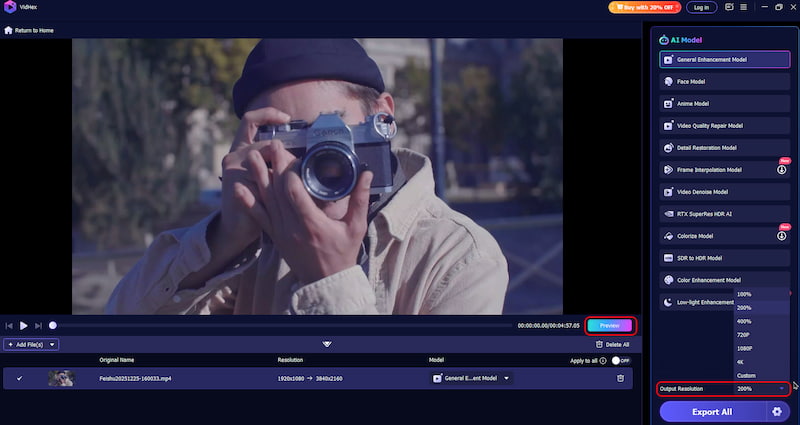
Step 1. Download and launch VidHex. Click the Add File(s) button to upload your videos.

Step 2. Once the video is imported, select the model you want to use. Different VidHex AI models have different effects on the video. We have General Enhancement Model, Face Model, Anime Model, Video Quality Repair Model, etc. Choose what you need.

Step 3. Before exporting, you can preview and choose the ideal resolution. Finally, select your output format and click Enhance All to save the enhanced video.
While VidHex isn't a "General AI" that can write your emails, it is the perfect example of how specialized strong AI algorithms are already changing our creative lives for the better.
Part 6. FAQs about General AI
Is ChatGPT considered a General AI?
ChatGPT is not a General AI. Although it is very advanced and capable of many tasks - from programming to writing - it is still considered to be a Narrow AI (also known as a Large Language Model). This is because it is working on the basis of statistical probability of text patterns and not on actual self-awareness or the ability to learn new tasks unrelated to texts.
When will we achieve true AI General Intelligence?
There has been no agreement on what could happen, but there have been two predictions that have emerged as probable outcomes. Some researchers, including those who work for OpenAI and DeepMind at Google, think that 'sparks' or flashes of strong AI might be possible by the year 2030, while some think that since 'the common sense and physical grounding problem has not yet been solved, general intelligence AI might be several decades or even a hundred years away.
What is the main difference between Strong AI and Super AI?
This is due to the amount of capability the robot possesses over and above that of a human.
• Strong AI or General AI: This type of AI is equal to human intelligence and has an ability to perform any tasks that a human being can do.
• Super AI (Artificial Superintelligence): This represents the hypothetical state of the future where the intelligence of the AI system exceeds the collective intelligence of human brains in every area of human endeavor in relation to creativity in science, social acumen, or common sense.
Conclusion
So, what is General AI? It is the horizon. It is the point where our creations cease to be just tools and become partners - or perhaps, successors.While General AI examples remain largely theoretical or fictional today, the rapid advancement of Narrow AI suggests that the gap is closing. We are moving from static algorithms to fluid, learning systems.
In the meantime, we have the privilege of using powerful, specialized AI that hints at this future. Tools like VidHex demonstrate that even without general consciousness, AI can master the complexities of visual perception and restoration, providing us with capabilities that were impossible just a decade ago.
The journey toward Strong AI is a marathon, not a sprint. Whether it arrives in ten years or a hundred, the pursuit of AI general intelligence forces us to ask the most fundamental question of all: What does it truly mean to be intelligent? As we continue to refine our definition of general ai, we are not just building better machines; we are learning more about the human mind itself.